Education
Piemonte, The Most Prestigious Wine Region In Italy?
Posted on February 3, 2021 in Education
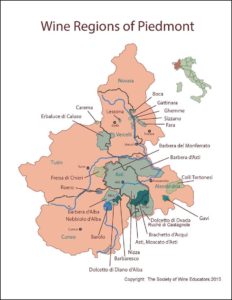
Piedmont, or Piemonte as it is called in Italy, is a prolific wine region producing some of the most sought after wines in the world. In fact, of the 573 Piemontese wines reviewed by Wine Spectator in 2020 a full 70% were ranked at 90 points or better!
Piemonte holds in its name the reference to the conformation of the region, located at the foot of mountains: “pie” stands for foot and “monte” for mountain. The name of the region perfectly describes its position at the foot of the Alps, which surround plains and hills on three sides. This geography provides a unique soil composition. The former sea & the consequent floods, erosion & earthquakes gave birth to a rich soil ideal for the wines of the region & the white truffles found there.
Of Italy’s 20 major wine regions, Piedmont ranks 6th in production volume & it’s known for its high quality, producing more DOCG (Denominazione di Origine Controllata e Garantita) designated wines than any other region. In fact, there are a total of 59 DOC/DOCG zones within the region (including Barolo, Gabiano, Barbera d’Asti, etc.) & the name of the region & zone are listed prominently on wine labels.
The diversity of the region – soil composition, topography, elevations, climate – results in a multitude of indigenous varietals complemented with a growing list of non-native grapes. Each zone has a primary varietal focus, however there is significant overlap with the same varietal being grown across different zones. Many think of Piemonte as mostly producing red wine, & while the best known & most sought after are red, the region also produces a significant number of white wines ranging from deeply flavored though light & bubbly.
The most common red varietals, Barbera, Dolcetto, & Nebbiolo, are produced in a number of zones resulting in variations based on locale.
Barbera is the most widely planted variety in Piedmont & delivers exceptional examples in d’Asti & d’Alba. These wines deliver aromas of red & black fruit – particularly raspberries, lingonberries, and blackberries – along with espresso, smoke, & anise, supported by velvety tannins & a spicy finish. The wines are typically aged in oak to deliver richer, opulent fruit flavors. These wines are medium-bodied with a touch of spicy-earthy terroir & most zones require a minimum of 75-90% of Barbera when blended. While common in the area, it is less well known across the wine-drinking world & usually offers good economic value.
Dolcetto, which translates to “little sweet one”, has soft, fruity flavors of plums, blackberries, and raspberries with aromas of violets & black peppercorn that are contrasted with firm tannin texture, often with hints of light chocolate. Exceptional producers are found in both DOCG and DOC areas (especially Alba). Typically dry, ruby-red in color with juicy cherry & almond notes., it boasts low-to-moderate acidity, as well as moderate alcohol (12% abv) and tannin levels so most recommend drinking the wine within 5 years of release, however top producers can age slightly longer.
Nebbiolo has high acidity, a pale garnet color, intense grippy tannins, flavors of cherry, rose and tar, as well as a moderately high alcohol content of 13–15%. These wines, especially with a decade of aging to soften tannins & integrate acidity, inspire flocks of devotees. While it’s produced in many of the subregions of Piedmont, Barolo, Barbaresco, & Langhe deserve special attention.
- – Barolo, known as “The King of Wines”, is comprised of 11 villages: Barolo, Castiglione Falletto, Serralunga d’Alba, Cherasco, Diano d’Alba, Grinzane Cavour, La Morra, Monforte d’Alba, Novello, Roddi and Verduno. Their name on a bottle means that all the grapes included in the wine were grown in that village. Regulations dictate that Barolo must age a minimum of 3 years before release, and 5 years for Riserva. To further ensure quality, only vineyards on southern-facing hills fall within the DOCG purview.
- – Barbaresco has four villages: Barbaresco, Neive, San Rocco Seno d’Elvio and Treiso & it also carries DOCG status for wine made from the best south-facing vineyards of Nebbiolo. Barbaresco grows primarily on a limestone base, which lowers tannins & highlights fruit similar to Barolo grown on blue-gray marl. Proximity to the river & lower elevations contribute to earlier ripening of grapes, a benefit in hotter years. Thinner skins translate into less tannin balanced against more fruit. As a result, Barbaresco tastes lighter than many Barolos.
- – Langhe is the broader region which encompasses both Barolo & Barbaresco. Wines made from Nebbiolo which either do not meet the stringent regulations of Barolo or Barbaresco (for instance grown on west facing hills) or that are made outside those two zones will usually carry Langhe as the source. These can be beautiful wines but will typically not command the high prices of a wine labeled as Barolo or Barbaresco, although there are certainly exceptions. Many of the high scoring & popular Gaja wines are from labeled from this region & most of the high-end Barolo & Barbaresco winemakers also produce wines from Langhe, focusing on the lighter cherry & fruit flavors it can deliver.
While less well known, Piemonte also produces some exceptional white wines. Moscato Bianco is the grape used in the popular sparkling wines including Asti Spumante & Moscato d’Asti. Less known but growing in popularity is Cortese di Gavi, a sleek dry white with a crisp and characteristically long, chalky finish that frames lemon, apple, melon, and straw flavors.
Enjoy a virtual visit to the region & sample across some of the diversity of wines that they produce:
Borgogno Langhe Nebbiolo 2014
Travaglini Gattinara 2016
Villa Sparina Monte Rotondo Comune di Gavi DOCG 2015
La Spinetta Langhe Nebbiolo
Elvio Cogno Mandorlo Dolcetto d’Alba 2013
Giacosa Fratelli Barbaresco 2015
Borgogno No Name Langhe Nebbiolo 2015
Pio Cesare Barolo 2014
References:
15 Best Wine Regions in Italy
Tuscany – It’s more than just Chianti!
Posted on January 19, 2021 in Education

The most well known Italian wine region has to be Tuscany, the home to Chianti. However, Tuscany is a lot more than just Chianti and Chianti is a lot more than the old wicker basket ensconced bottle. The region produces nearly 53 million gallons of wine a year, with the vast majority (~85%) being red. And of these red wines, Sangiovese is the dominant player.
Part of the challenge in discussing Italian wines – or most European wines for that matter – is the nomenclature surrounding the wine. As is typical across Europe, Italian wines are known by the region where they are produced and it is up to the drinker to understand what varietals are actually in the bottle. While you can rest assured that a Cabernet Sauvignon can be called a Napa Cab as long as it has 80+% Cabernet grapes grown in the defined Napa region, what can you divine considering a Chianti vs a Chianti Classico or a Chianti Ruffino? While each has Sangiovese as its base wine and all 3 come from Tuscany, each has different regulations and comes from different areas.
Let’s first discuss the region: Within Tuscany there are nearly 40 sub-appellations containing 11 DOCG, 40 DOC, and 6 IGT classifications. Nearly ⅔ of Tuscan wine production is DOC and DOCG. The most widely known include Chianti, Chianti Classico, Brunello di Montepulciano, Vino di Nobile Montepulciano, Bolgheri, Rosso di Montalcino, Toscano, and Vin Santo. Due to climate, soil composition, and topography, each has its own style and specialty, but Sangiovese remains the dominant red grape across each sub-region.
While regions along the coast, primarily Bolgheri, have lower elevations and are therefore warmer, they are also influenced by the Mediterranean allowing non-native grapes, such as Cabernet and Merlot, to flourish. Further inland it is hilly with some rising peaks producing a cooler growing climate and shifting soil structure. This is where Chianti and most of its sub-appellations are located, and further to the south Montalcino and Montepulciano. These regions are ideal for Sangiovese and some other lesser known indigenous varietals.
Grapes in the bottle: Sangiovese is the base for the majority of the better known wines in Tuscany – Chianti and all its sub-appellations, Brunello, Rosso di Montepulciano, Rosso di Montalcino, and Vino Nobile di Montepulciano. It is a thin-skinned grape, so it makes lighter, translucent wines. In the glass, it is a ruby red color with flashes of bright burnt orange –a hue commonly associated with aged wines. Besides Sangiovese, Chianti wines may contain grapes like Canaiolo, Colorino, Cabernet Sauvignon, and even Merlot, while Brunello is 100% Sangiovese Grosso, a clone of Sangiovese.
(more…)
The Wines of Italy – Where to Start?
Posted on January 6, 2021 in Education
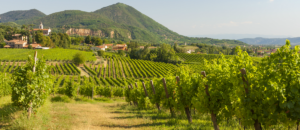
Italian Wine Discovery
You’d be forgiven if you assumed that wine originated in Italy. In fact, it is believed that the origins of wine date back nearly 4,000 years ago to the area that was Mesopotamia. But, while the Greeks may have brought the first vines to Scicly over 3,000 years ago, the Italians have raised the production of wine to an art form. It has one of the most diverse selections of grapes and is the world’s largest producer of wine. With 1.7 million acres of vineyards producing nearly 50 billion litres of wine per year, there is something for every taste.
Reading an Italian wine label can be confusing and overwhelming, but it is key to understanding what to expect in the bottle. There are 20 wine producing regions in Italy and they are governed by an appellation system:
VdT – Vino Da Tavola
(Table Wine)
The most basic classification for the wines of Italy. It is now renamed simply as “Vino”, appearing on labels as Vino d’Italia. This designates wines that reside firmly on the “low end” of the totem pole, comprised of Italian table wines, whose only criteria is that they must be produced somewhere in Italy.
IGT – INDICAZIONE GEOGRAFICA TIPICA
(Typical Geographic Indication)
The wine’s label must declare its specific region and may cite varietal type and vintage. Growers or regional governments are required to apply for IGT status just as they do for a DOC or DOCG appellation.
DOC – DENOMINAZIONE DI ORIGINE CONTROLLATA
(Denomination of Controlled Origin)
A wine with this mark on the label has been produced in a specified area and has been aged and bottled in accordance with existing regulations and under strict control by the Italian Authorities. Along with specifying barrel and bottle aging requirements, this may control min/max production levels, and ABV.
DOCG – DENOMINAZIONE DI ORIGINE CONTROLLATA E GARANTITA
(Denomination of Controlled and Guaranteed Origin)
This category is reserved for elite wines whose quality is “guaranteed” by the Italian Government. These wines can be sold only in bottles not exceeding a certain size and each bottle bears a seal of guarantee.
Japanese Whiskies, what is the fuss all about?
Posted on December 20, 2020 in Education
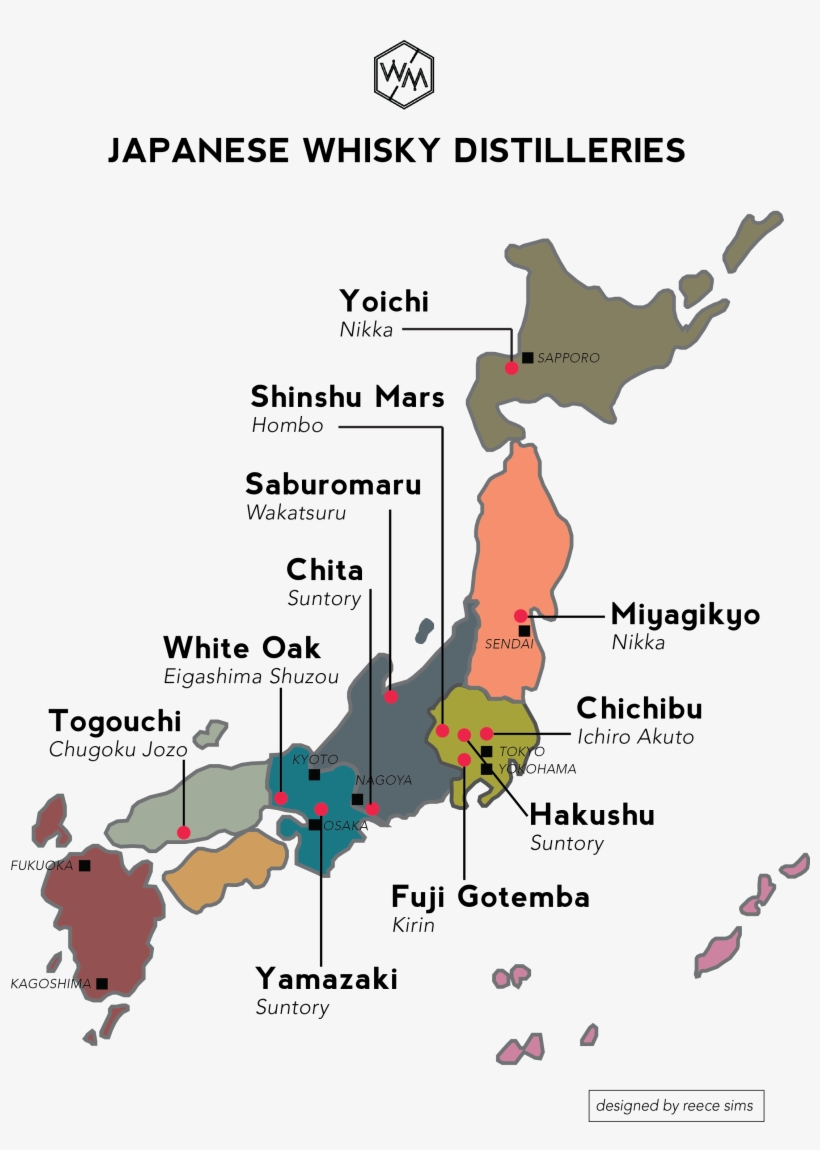
If you are seeking out Yamazaki 18 years old, good luck. Yes they are out there, but they are incredibly hard to come by. Since 2007, I think we have been able to procure about 3 bottles and we specialize in whisky (or so we like to think). In 2008 there were only a handful of Japanese whiskies available in the USA. Hibiki, Yamazaki and a handful of expressions from the Nikka Distilleries. The popularity of Japanese whiskies has steadily increased worldwide and many of age stated whiskies have all but disappeared. Fortunately there have been a number of other Japanese whiskies that are now being imported and that is great news for the consumer.
As of today we have 51 different Japanese whiskies in stock. Here is the complete list, you are bound to find one you like. We have put many on sale, sale will run through the end of 2020.
Whisky is produced worldwide and is essentially distilled cereal grain. Every country has their own set of styles and production methods. Japan is no different, though it must be said Japanese whisky draws inspiration and is greatly influenced by Scotch.
The rapidly growing Japanese whisky industry has been largely attributed to its two founding fathers: Shinjiro Torii and Masataka Taketsuru. Shinjiro established the Suntory brand and the first distillery in Japan in 1923, Yamazaki in the Vale of Yamazaki. Taketsuru founded Yoichi on Hokkaido eleven years later in 1934. Today, Japanese whiskies are becoming increasingly popular and in a unique style of their own.
What is Japanese Whisky?
It is difficult to say with certainty, it is a lot of things. Unlike Scotch Whisky, Bourbon and American Rye whiskey Japanese whiskies does not have “rules”. Japanese whiskies heritage is without question Scottish, thanks to Masataka Taketsuru’s enduring influence, Japanese whisky has created its own style and feel. All of the following make Japanese whisky compelling and unique. (more…)
Bruichladdich Distillery
Posted on December 19, 2020 in Education
Bruichladdich
Pronounced: brook-LAH-dee
Translation: Gaelic ‘the Brae (hillside) by the shore’
Region: Islay (Lochindaal)
Established: 1881
Website: http://www.bruichladdich.com/
Production Capacity: 1,500,000 litres of pure alcohol per year
Water Source: Spring at Octomore farm
Owner: Remy Cointreau
Master Distiller: Jim McEwan (retired 2015), Adam Hannett is the current Head Distiller.
House Style: Various
Temporary Closures: 1929 (reopens 1936), 1983 (in production for a few months 1998), reopens 2001.
Single Malts from Bruichladich at Norfolk Wine and Spirits. Sale items will stay “On Sale” through 2020 or while supplies last. Click here for a complete list.
Islay single malts evoke great passion among its followers. Islay whiskies are most famous for their peated whiskies. Bruichladdich produces a variety of staples of whisky. From unpeated to heavily peated to the most peated whisky in the history of mankind (claim made by us). They have also released some exceptional unpeated wine finished/matured whiskies named Black Art. If that was not enough, they even produce a lovely gin, the Botanist. And more… on occasion release a quadruple distilled single malt!
Bruichladdich is Scotland’s most westerly distillery, second only to Kilchoman. It is located on the western peninsula of Islay on the edge of Loch Indaal and looks across the water to the Bowmore distillery on the opposite shore. The distillery was built using stones from the local beach and was also one of the first buildings in the UK to use concrete in its construction. Despite its location on Islay, which is the home of smoky whisky, Bruichladdich has traditionally been produced as a non smoky whisky and the core range remains as such today. New owners have turned Bruichladdich into one of most innovative distilleries, as they break from tradition and experiment with different wine casks to mature their whisky.
History
In 2004 Bruichladdich was the first distillery to grow barley locally on Islay for its single malts, probably the first time this had been done in the island’s history. It now works with 19 local farms, releasing the whiskies in its Islay Barley single vintage series. It is also a major distiller of organic barley and explores heritage barleys such as Bere Barley, and has even begun distilling rye.
On 19th, a group of private investors led by Mark Reynier and Simon Coughlin acquired Bruichladdich for £6.5 million (US$10.3m) from Beam Inc. through Murray McDavid (an independent whisky bottlers). Mark persuaded Jim McEwan, the respected distiller, native islander and raconteur to leave his position as distillery manager at Bowmore, the Islay distillery where he started work at the age of 15 in 1963 as a cooper, to become Production Director at Bruichladdich.
The distillery had never been modernised and most of the original Victorian equipment remained. Between January and May 2001 this was all dismantled and reassembled to return the plant to working order, augmented by the acquisition of some second-hand equipment. They started distilling again on 11th September 2001. (more…)
Vintage Port
Posted on October 30, 2020 in Education
Vintage Port, the most expensive and prestigious member of the Port family, only accounts for a fraction of total Port production, but Vintage Port is the Douro’s flagship style, attracting attention and speculation the world over.
A Vintage is “declared” in only the best years, when both the quality and quantity of the available fruit align. It may take up to two years after harvest for a vintage declaration to be made, and even when one Port shipper judges the conditions sufficient for Vintage Port, other shippers may not necessarily agree. This scenario is highly unusual, though, and has only occurred a handful of times in history.
Vintage Port is made from the best grapes in the Douro, typically from the Cima Corgo subregion. The grapes are left to achieve full ripeness before they are picked, vinified and then fortified with high-proof grape spirit. Vintage Port spends a short time aging in barrel – only two to three years – and is bottled, unfiltered, when it is still very dense and full of sediment. This is why Vintage Port’s minimum bottle-aging period is considered to be 15 years, and it is often said that no other wine requires as much time in bottle to balance itself. The finest examples are capable of vitality well after 50 years.
Recent critical successes have helped bring about a renewal of interest in the style, and Vintage Port is often considered as an addition to the cellar as much as Bordeaux or Burgundy. Decanting Vintage Port prior to serving is necessary, as the sediment in the bottle becomes crusty over time.
Decoding Sake, a beverage for all Occasions!
Posted on October 19, 2020 in Education
Just like the origin of mead, beer, whisky and wine the origin of sake is unclear. Sake production dates back to at least a 1,000 years, some believe they have been perfecting sake for over 1,500 years.
Sake commonly referred to as Japanese rice wine is produced in a process that has more in common with beer than wine. It is brewed using highly polished sake mai rice, water, a mold called Aspergillus oryzae (also used in the fermentation of soy sauce), and yeast.
There are over 270 varieties of rice cultivated in Japan and about 100 are are explicitly made for sake brewing. Scotland may have about 120 distilleries making whisky and Japan has about 1,500 Sake producers. While 90% of the Scotch produced in Scotland is exported and 20-30% of wine produced in France and Italy, only 3% of Sake produced in Japan is exported. The rest of the world has a lot to catching up to do and learn about Sake.
All Sakes you will ever drink fall into one of main two categories. The pure rice style (called “junmai” in Japanese) or the alcohol-added style (called “aruten” in Japanese). Pure rice sakes are sakes that are made with only rice, water, yeast and koji, with no additives of any kind. Alcohol-added sakes use the same ingredients as pure rice sakes, but they add a small amount of distilled brewers alcohol (a neutral distilled alcohol) to the mash. This alcohol is added to influence the body, aroma and viscosity of the sake. When it comes to milling rice in the case of , the more the sake rice is polished down, the more premium (upto 50% or less of its original weight) and expensive the sake will tend to be.
Irish Whiskey
Posted on September 7, 2020 in Education
Ireland is the birthplace of whiskey. The word ‘whiskey’ (or whisky) comes from the Irish (or ‘Gaelic’) uisce beatha, meaning water of life. Irish whiskey was once the most popular spirit in the world, with a 60% share of the world export market before declining precipitously. In 1835, there were 93 legal distilleries in Ireland. By 1900, there were about 150. However, a combination of factors that included Irish Independence, two World Wars, prohibition in the US, and the failure to adopt Column distilling at an early stage all contributed in decimating this once flourishing industry. In the 1970’s there were only two Irish whiskey distilleries left, with Cooley Distillery coming into being as the third in 1987.
Irish whiskey has recently seen a resurgence and is back on its feet with over 32 active distilleries and many more in the various stages of planning. Irish Distillers is one of the most recognized distilleries and came into being in 1966 through the merger of various Irish distilleries. They produce many popular brands such as Jameson, Powers, Redbreast, Middleton, the Spots (Green, Yellow, Red) and Method and Madness.
There is a lot of variety in Irish Whiskey and much overlap among styles from other countries. The major categories are Blended, Grain, Single Malt and Pot Still. Once the most popular style in the world, single pot still whiskey is a style of Irish whiskey made by a single distillery from a mixed mash of malted and unmalted barley distilled in a pot still.