Piemonte, The Most Prestigious Wine Region In Italy?
Posted on February 3, 2021 in Education

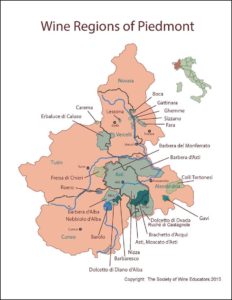
Piedmont, or Piemonte as it is called in Italy, is a prolific wine region producing some of the most sought after wines in the world. In fact, of the 573 Piemontese wines reviewed by Wine Spectator in 2020 a full 70% were ranked at 90 points or better!
Piemonte holds in its name the reference to the conformation of the region, located at the foot of mountains: “pie” stands for foot and “monte” for mountain. The name of the region perfectly describes its position at the foot of the Alps, which surround plains and hills on three sides. This geography provides a unique soil composition. The former sea & the consequent floods, erosion & earthquakes gave birth to a rich soil ideal for the wines of the region & the white truffles found there.
Of Italy’s 20 major wine regions, Piedmont ranks 6th in production volume & it’s known for its high quality, producing more DOCG (Denominazione di Origine Controllata e Garantita) designated wines than any other region. In fact, there are a total of 59 DOC/DOCG zones within the region (including Barolo, Gabiano, Barbera d’Asti, etc.) & the name of the region & zone are listed prominently on wine labels.
The diversity of the region – soil composition, topography, elevations, climate – results in a multitude of indigenous varietals complemented with a growing list of non-native grapes. Each zone has a primary varietal focus, however there is significant overlap with the same varietal being grown across different zones. Many think of Piemonte as mostly producing red wine, & while the best known & most sought after are red, the region also produces a significant number of white wines ranging from deeply flavored though light & bubbly.
The most common red varietals, Barbera, Dolcetto, & Nebbiolo, are produced in a number of zones resulting in variations based on locale.
Barbera is the most widely planted variety in Piedmont & delivers exceptional examples in d’Asti & d’Alba. These wines deliver aromas of red & black fruit – particularly raspberries, lingonberries, and blackberries – along with espresso, smoke, & anise, supported by velvety tannins & a spicy finish. The wines are typically aged in oak to deliver richer, opulent fruit flavors. These wines are medium-bodied with a touch of spicy-earthy terroir & most zones require a minimum of 75-90% of Barbera when blended. While common in the area, it is less well known across the wine-drinking world & usually offers good economic value.
Dolcetto, which translates to “little sweet one”, has soft, fruity flavors of plums, blackberries, and raspberries with aromas of violets & black peppercorn that are contrasted with firm tannin texture, often with hints of light chocolate. Exceptional producers are found in both DOCG and DOC areas (especially Alba). Typically dry, ruby-red in color with juicy cherry & almond notes., it boasts low-to-moderate acidity, as well as moderate alcohol (12% abv) and tannin levels so most recommend drinking the wine within 5 years of release, however top producers can age slightly longer.
Nebbiolo has high acidity, a pale garnet color, intense grippy tannins, flavors of cherry, rose and tar, as well as a moderately high alcohol content of 13–15%. These wines, especially with a decade of aging to soften tannins & integrate acidity, inspire flocks of devotees. While it’s produced in many of the subregions of Piedmont, Barolo, Barbaresco, & Langhe deserve special attention.
- – Barolo, known as “The King of Wines”, is comprised of 11 villages: Barolo, Castiglione Falletto, Serralunga d’Alba, Cherasco, Diano d’Alba, Grinzane Cavour, La Morra, Monforte d’Alba, Novello, Roddi and Verduno. Their name on a bottle means that all the grapes included in the wine were grown in that village. Regulations dictate that Barolo must age a minimum of 3 years before release, and 5 years for Riserva. To further ensure quality, only vineyards on southern-facing hills fall within the DOCG purview.
- – Barbaresco has four villages: Barbaresco, Neive, San Rocco Seno d’Elvio and Treiso & it also carries DOCG status for wine made from the best south-facing vineyards of Nebbiolo. Barbaresco grows primarily on a limestone base, which lowers tannins & highlights fruit similar to Barolo grown on blue-gray marl. Proximity to the river & lower elevations contribute to earlier ripening of grapes, a benefit in hotter years. Thinner skins translate into less tannin balanced against more fruit. As a result, Barbaresco tastes lighter than many Barolos.
- – Langhe is the broader region which encompasses both Barolo & Barbaresco. Wines made from Nebbiolo which either do not meet the stringent regulations of Barolo or Barbaresco (for instance grown on west facing hills) or that are made outside those two zones will usually carry Langhe as the source. These can be beautiful wines but will typically not command the high prices of a wine labeled as Barolo or Barbaresco, although there are certainly exceptions. Many of the high scoring & popular Gaja wines are from labeled from this region & most of the high-end Barolo & Barbaresco winemakers also produce wines from Langhe, focusing on the lighter cherry & fruit flavors it can deliver.
While less well known, Piemonte also produces some exceptional white wines. Moscato Bianco is the grape used in the popular sparkling wines including Asti Spumante & Moscato d’Asti. Less known but growing in popularity is Cortese di Gavi, a sleek dry white with a crisp and characteristically long, chalky finish that frames lemon, apple, melon, and straw flavors.
Enjoy a virtual visit to the region & sample across some of the diversity of wines that they produce:
Borgogno Langhe Nebbiolo 2014
Travaglini Gattinara 2016
Villa Sparina Monte Rotondo Comune di Gavi DOCG 2015
La Spinetta Langhe Nebbiolo
Elvio Cogno Mandorlo Dolcetto d’Alba 2013
Giacosa Fratelli Barbaresco 2015
Borgogno No Name Langhe Nebbiolo 2015
Pio Cesare Barolo 2014
References:
15 Best Wine Regions in Italy