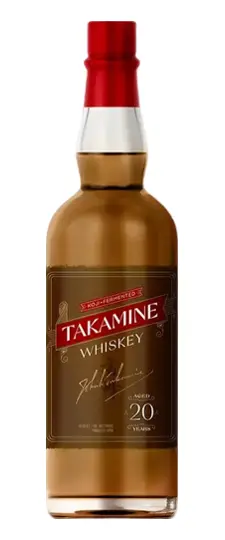
Takamine Whiskey 20 Year Old (43.1% ABV)
$299.99
Here’s a rare chance to acquire some of the most distinctive Japanese whiskies available on the market today. Each Takamine selection is 100% fermented, distilled, aged, and bottled at Shinozaki Distillery in Fukuoka, Japan, using polished barley, white koji, and Fukuoka yeast. Aged for 17 to 23 years in the distillery’s thick concrete walls, these whiskies develop exceptional depth and complexity, embodying the essence of Fukuoka terroir. These Takamine releases are among the longest-aged ever from Shinozaki and include 17-year and 20-year bottlings matured in seasoned American white oak, and a 23-year variant aged in fresh PX Sherry butts. Act quickly to secure these extraordinary whiskies before they arrive from Japan.
This whisky is made entirely from polished barley fermented with white koji and Fukuoka yeast. They are double distilled on pot stills and are proofed between runs to achieve a natural still strength of around 45%. They enter the cask at still strength and are aged in Shinozaki Distillery’s former municipal rice bunker turned aging facility. The facility has thick concrete walls and ceilings (much like MGP) which creates a cave like environment resulting in unusually graceful maturation of these whiskies in a warm climate. This rare parcel of heavily aged barrels was hand selected from some of the distillery’s initial experimentation with this new production style. While the whiskies are not malted, they achieve a great deal of depth and complexity and represent the finest and oldest grain whiskies coming out of Japan today. The selected casks -3988, 3989, 7136, 7137- were distilled on June 3rd, 2003 & March 27th, 2004. The barrels in question were 450L Ariake Cooperage American White Oak, medium char seasoned in for many years with barley shochu. These whiskies are 100% fermented, distilled, aged, and bottled in Fukuoka, Japan. They are the longest aged products ever produced and released by Shinozaki Distillery and will not be matched in age again for many years to come (if ever). This barrels are bottled without chillfiltration at cask strength of 43.1% abv without any coloring or additives whatsoever.
Takamine Koji Whiskey is made with the patented Takamine Process, which uses an ancient Japanese mold, koji, to convert starches to sugars in a process similar to malting barley. Unlike malt whiskey where sugars are extracted in a warm water mash before yeast is introduced to start the fermentation, both the koji and yeast are active at the same time in a multiple parallel fermentation. This 100% barley ferment is then double distilled and aged in virgin oak and ex-Bourbon casks to give the spirit its natural golden color and deep, lush flavors.
What is koji?
For over 1,200 years Japanese craftspeople have used koji as the foundation of Japanese fermentation. Soy sauce, miso paste, mirin cooking wine, sake, and other classic Japanese foods and beverages would not exist as they do today without koji. Koji is so central to Japanese culinary traditions that it has been designated the national mold of Japan (that is not a joke). When carefully cultivated on rice, barley, or other grains koji creates an amylase enzyme, which converts starches to sugars. This allows yeast to do its job. In fact, koji is so efficient that Japanese sake is the highest natural alcohol fermentation in the world with some sake reaching above 20 percent alcohol. In the case of Takamine Whiskey, koji mold is propagated on steamed pearled 2-row barley and nurtured for two days in an environment with perfect heat and humidity to optimize koji growth. This kojified barley is then moved to a fermentation tank where water, yeast, and additional freshly steamed barley are added. This fermentation process lasts nearly 2 weeks during which the koji will continue to convert the barley to sugars for the yeast to make alcohol. The final fermentation is 19% alcohol.
Behind the Dream
Jokichi Takamine (1854-1922) was born into a sake making family before graduating from Tokyo Imperial University. The young biochemist spent his early career finding medicinal uses for koji which included patenting Takamine Diastase, a stomach aide, that would go on to be popular in both the US and Japan. He was encouraged to move to Chicago in 1890 due to the Illinois Whisky Trust’s interest in his Takamine Process, which he patented in 1891. Experiments began at the Manhattan Distillery in Peoria, Illinois, but the building was destroyed in a mysterious fire shortly thereafter.
Takamine’s whiskey would not reach production until December 1894, but this would be short lived. The distillery entered receivership in early 1895 and the new owners returned to standard malting, abandoning the new process. Professor Takamine would move to New York City where he would have a very successful career as a chemist, even isolating adrenaline for the first time. In 1910 he donated over 2,000 cherry blossom trees to Washington DC, which still bring joy to visitors today.
His whiskey dream was never realized.
Shinozaki
Brewery & Distillery
Asakura City, Fukuoka Prefecture, Japan
Shinozaki Brewery and Distillery has been making premium sake since the mid-1800s and has been creating beautiful koji spirits since 1979. Nearly four decades ago, Michiaki Shinozaki, learning of Professor Takamine’s story, was inspired to revive the Takamine Process in Japan. He experimented with fermentation types, distillation methods, and barrel aging until he and his team of craftsmen had found the perfect expression. His family acquired a former municipal grain storage warehouse to expand barrel aging capacity in order to ramp up production.
Finally satisfied with the whiskey he created, Mr. Shinozaki approached the Takamine Family Trust for permission to use the professor’s name. They agreed, the first time the trust has ever granted the use of his name for a commercial product.
At long last, the Takamine Process can be experienced by the great grandchildren of Takamine’s intended customers.
Only 2 left in stock